Bank Tellers
Overview
Bank tellers are the friendly faces of banking who help customers with their money needs every day. They handle cash deposits and withdrawals, process checks, exchange foreign currency, and answer questions about accounts using modern banking software and security systems. This job requires strong math skills, attention to detail, and excellent customer service abilities. Many bank tellers work in collaborative team environments and can advance to supervisory roles or other banking careers with on-the-job training and additional education.
Did you know?
Banking assistants must understand federal regulations like the Bank Secrecy Act and FDIC requirements that govern American financial institutions.
At a Glance
Median Wage
$40,236.86 Avg/yr
Growth
Stable
Top Skill
Operations Analysis
Key Responsibilities
- Perform clerical tasks, such as typing, filing, and microfilm photography.
- Process and maintain records of customer loans.
- Balance currency, coin, and checks in cash drawers at ends of shifts and calculate daily transactions, using computers, calculators, or adding machines.
- Explain, promote, or sell products or services, such as travelers' checks, savings bonds, money orders, and cashier's checks, using computerized information about customers to tailor recommendations.
- Carry out special services for customers, such as ordering bank cards and checks.
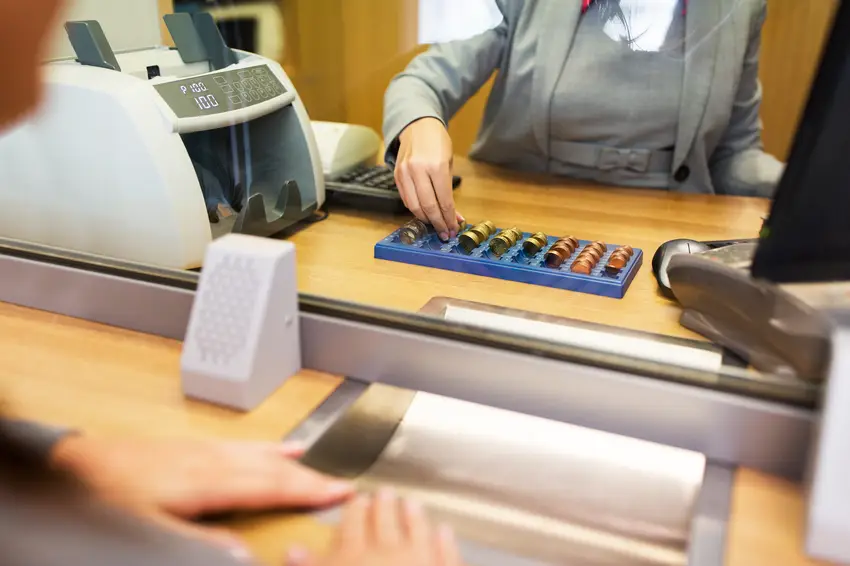
- Arrange monies received in cash boxes and coin dispensers according to denomination.
- Inform customers about foreign currency regulations and compute transaction fees for currency exchanges.
- Enter customers' transactions into computers to record transactions and issue computer-generated receipts.
- Quote unit exchange rates, following daily international rate sheets or computer displays.
- Count, verify, and post armored car deposits.
- Issue checks to bond owners in settlement of transactions.
- Receive and count daily inventories of cash, drafts, and travelers' checks.
- Examine checks for endorsements and to verify other information, such as dates, bank names, identification of the persons receiving payments, and the legality of the documents.
- Identify transaction mistakes when debits and credits do not balance.
- Resolve problems or discrepancies concerning customers' accounts.
- Receive checks and cash for deposit, verify amounts, and check accuracy of deposit slips.
- Answer telephones and assist customers with their questions.
- Obtain and process information required for the provision of services, such as opening accounts, savings plans, and purchasing bonds.
- Sort and file deposit slips and checks.
- Process transactions, such as term deposits, retirement savings plan contributions, automated teller transactions, night deposits, and mail deposits.
- Compose, type, and mail customer statements and other correspondence related to issues such as discrepancies and outstanding unpaid items.
- Compute financial fees, interest, and service charges.
- Cash checks and pay out money after verifying that signatures are correct, that written and numerical amounts agree, and that accounts have sufficient funds.
- Monitor bank vaults to ensure cash balances are correct.
- Prepare and verify cashier's checks.
- Count currency, coins, and checks received, by hand or using currency-counting machine, to prepare them for deposit or shipment to branch banks or the Federal Reserve Bank.
- Order a supply of cash to meet daily needs.
- Receive mortgage, loan, or public utility bill payments, verifying payment dates and amounts due.
Career Considerations
Regulatory Compliance Knowledge
Banking assistants must understand federal regulations like the Bank Secrecy Act and FDIC requirements that govern American financial institutions.
Digital Banking Proficiency
Proficiency with online banking platforms and fintech tools is essential as American banks increasingly digitize their services.
Career Advancement Pathways
Entry-level positions often lead to roles like personal banker, loan officer, or branch manager within the structured hierarchy of American banks.