
Print Binding and Finishing Workers

Overview

Print binding and finishing workers create the final versions of books, magazines, and other printed materials by assembling pages and adding covers using specialized machines and hand tools. They operate high-tech binding equipment, stitch or glue pages together, trim edges to perfect sizes, and inspect finished products for quality issues like torn pages or loose bindings. These workers also maintain and adjust complex machinery, monitor automated processes, and keep detailed production records. Many positions offer hands-on technical training and opportunities to work with both traditional craftsmanship and modern digital printing technology.
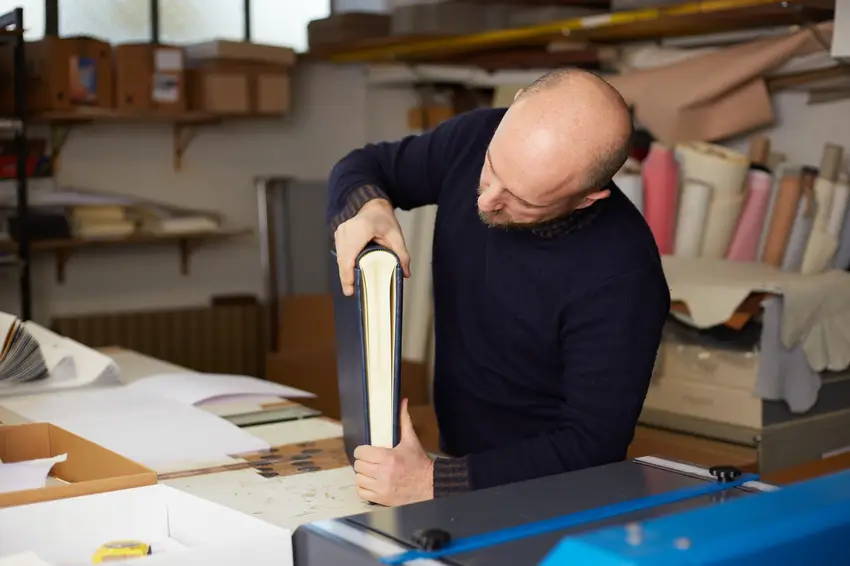
Print Binding and Finishing Workers

Did you know?

Print Production Specialists must stay current with evolving digital printing technologies and software as the industry shifts away from traditional offset printing methods.

At a Glance

Median Wage

$41,805.83 Avg/yr

Growth

Stable

Top Skill

Management of Personnel Resources

Key Responsibilities

  • Cut binder boards to specified dimensions, using board shears, hand cutters, or cutting machines.
  • Compress sewed or glued signatures, using hand presses or smashing machines.
  • Maintain records, such as daily production records, using specified forms.
  • Stitch or glue endpapers, bindings, backings, or signatures, using sewing machines, glue machines, or glue and brushes.
  • Set up or operate glue machines by filling glue reservoirs, turning switches to activate heating elements, or adjusting glue flow or conveyor speed.
  • Cut cover material to specified dimensions, fitting and gluing material to binder boards by hand or machine.
  • Punch holes in and fasten paper sheets, signatures, or other material, using hand or machine punches and staplers.
  • Monitor machine operations to detect malfunctions or to determine whether adjustments are needed.
  • Imprint or emboss lettering, designs, or numbers on book covers, using gold, silver, or colored foil, and stamping machines.
  • Bind new books, using hand tools such as bone folders, knives, hammers, or brass binding tools.
  • Trim edges of books to size, using cutting machines, book trimming machines, or hand cutters.
  • Read work orders to determine instructions and specifications for machine set-up.
  • Examine stitched, collated, bound, or unbound product samples for defects, such as imperfect bindings, ink spots, torn pages, loose pages, or loose or uncut threads.
  • Set up or operate machines that perform binding operations, such as pressing, folding, or trimming.
  • Lubricate, clean, or make minor repairs to machine parts to keep machines in working condition.
  • Train workers to set up, operate, and use automatic bindery machines.
  • Prepare finished books for shipping by wrapping or packing books and stacking boxes on pallets.
  • Repair, restore, or rebind old, rare, or damaged books, using hand tools.
  • Insert book bodies in devices that form back edges of books into convex shapes and produce grooves that facilitate cover attachment.
  • Meet with clients, printers, or designers to discuss job requirements or binding plans.
  • Perform highly skilled hand finishing binding operations, such as grooving or lettering.
  • Design original or special bindings for limited editions or other custom binding projects.
  • Install or adjust bindery machine devices, such as knives, guides, rollers, rounding forms, creasing rams, or clamps, to accommodate sheets, signatures, or books of specified sizes.
  • Set up or operate bindery machines, such as coil binders, thermal or tape binders, plastic comb binders, or specialty binders.
  • Form book bodies by folding and sewing printed sheets to form signatures and assembling signatures in numerical order.

Career Considerations

Digital Technology Adaptation

Print Production Specialists must stay current with evolving digital printing technologies and software as the industry shifts away from traditional offset printing methods.

Industry Consolidation Impact

The American print industry has experienced significant consolidation with many smaller print shops closing, making it essential to target larger commercial printers or specialized niche markets.

Cross-Functional Skill Development

Professionals should develop complementary skills in graphic design, project management, and digital marketing to remain competitive in the evolving print landscape.

Want to dig deeper?

Talk to blinky to learn more.

Start chatting
BETA
New York

25 Kent Ave, Suite 401
Brooklyn, NY
11249


North Carolina

204 N Person
Street. Raleigh, NC
27601

Australia

Level 4/80
Wentworth Ave,
Surry Hills,
Sydney, 2010