
Printing Press Operators

Overview

Printing Press Operators set up and run various types of printing machines, from digital printers to traditional letterpress and lithographic equipment. They handle everything from loading paper and mixing inks to adjusting machine settings and checking print quality throughout production runs. This hands-on job requires technical skills, attention to detail, and the ability to troubleshoot equipment issues. Many operators learn through on-the-job training or vocational programs, and they work in print shops, newspapers, packaging companies, and commercial printing facilities.
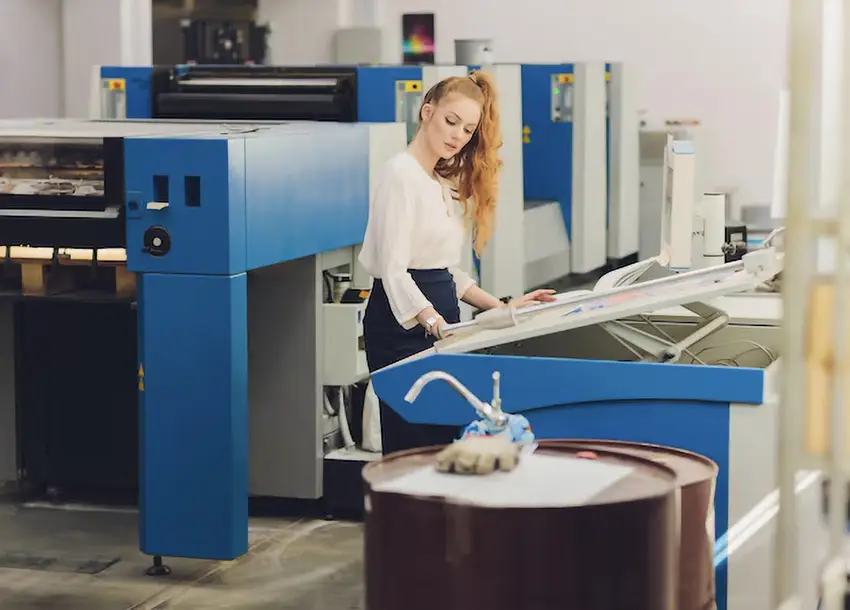
Printing Press Operators

Did you know?

The traditional printing industry in America has been shrinking due to digital media growth, requiring technicians to adapt to changing market demands and potentially fewer job opportunities.

At a Glance

Median Wage

$44,725.10 Avg/yr

Growth

Stable

Top Skill

Operation and Control

Key Responsibilities

  • Start presses and pull proofs to check for ink coverage and density, alignment, and registration.
  • Monitor inventory levels on a regular basis, ordering or requesting additional supplies, as necessary.
  • Feed paper through press cylinders and adjust feed and tension controls.
  • Clean or oil presses or make minor repairs, using hand tools.
  • Monitor environmental factors, such as humidity and temperature, that may impact equipment performance and make necessary adjustments.
  • Secure printing plates to printing units and adjust tolerances.
  • Set up or operate auxiliary equipment, such as cutting, folding, plate-making, drilling, or laminating machines.
  • Adjust digital files to alter print elements, such as fonts, graphics, or color separations.
  • Input production job settings into workstation terminals that control automated printing systems.
  • Adjust ink fountain flow rates.
  • Control workflow scheduling or job tracking, using computer database software.
  • Verify that paper and ink meet the specifications for a given job.
  • Direct or monitor work of press crews.
  • Collect and inspect random samples during print runs to identify any necessary adjustments.
  • Download or scan files to be printed, using printing production software.
  • Change press plates, blankets, or cylinders, as required.
  • Download completed jobs to archive media so that questions can be answered or jobs replicated.
  • Examine job orders to determine quantities to be printed, stock specifications, colors, or special printing instructions.
  • Load presses with paper and make necessary adjustments, according to paper size.
  • Monitor automated press operation systems and respond to fault, error, or alert messages.
  • Clean ink fountains, plates, or printing unit cylinders when press runs are completed.
  • Maintain time or production records.
  • Obtain or mix inks and fill ink fountains.

Career Considerations

Industry Decline and Digital Transformation

The traditional printing industry in America has been shrinking due to digital media growth, requiring technicians to adapt to changing market demands and potentially fewer job opportunities.

Technology Skills Development

Modern printing technicians must continuously learn new digital printing technologies, computer-controlled equipment, and software systems to remain competitive in the evolving American job market.

Specialization Opportunities

Career advancement often requires specializing in high-demand areas such as packaging printing, large-format printing, or 3D printing technologies that serve growing American market segments.

Want to dig deeper?

Talk to blinky to learn more.

Start chatting
BETA
New York

25 Kent Ave, Suite 401
Brooklyn, NY
11249


North Carolina

204 N Person
Street. Raleigh, NC
27601

Australia

Level 4/80
Wentworth Ave,
Surry Hills,
Sydney, 2010