
Refrigeration Equipment Operators

Overview

Refrigeration equipment operators run the machines that keep food, medicines, and other products fresh by controlling cooling and freezing systems. You'll monitor digital displays, adjust temperature controls, load products into freezing tunnels, and record data to ensure everything stays at the right temperature. This job combines hands-on work with technology, using computerized systems to maintain quality and safety standards. Many operators start with a high school diploma and learn through on-the-job training in food processing plants, pharmaceutical companies, or cold storage facilities.
Refrigeration Equipment Operators

Did you know?

Cooling technicians must obtain EPA Section 608 certification to legally handle refrigerants, which is mandatory for most HVAC and refrigeration work in the United States.

At a Glance

Median Wage

$43,145.59 Avg/yr

Growth

Fast Growing

Top Skill

Technology Design

Key Responsibilities

  • Measure or weigh specified amounts of ingredients or materials, and load them into tanks, vats, hoppers, or other equipment.
  • Assemble equipment, and attach pipes, fittings, or valves, using hand tools.
  • Insert forming fixtures, and start machines that cut frozen products into measured portions or specified shapes.
  • Inspect and flush lines with solutions or steam, and spray equipment with sterilizing solutions.
  • Weigh packages and adjust freezer air valves or switches on filler heads to obtain specified amounts of product in each container.
  • Monitor pressure gauges, ammeters, flowmeters, thermometers, or products, and adjust controls to maintain specified conditions, such as feed rate, product consistency, temperature, air pressure, and machine speed.
  • Record temperatures, amounts of materials processed, or test results on report forms.
  • Start agitators to blend contents, or start beater, scraper, and expeller blades to mix contents with air and prevent sticking.
  • Sample and test product characteristics such as specific gravity, acidity, and sugar content, using hydrometers, pH meters, or refractometers.
  • Read dials and gauges on panel control boards to ascertain temperatures, alkalinities, and densities of mixtures, and turn valves to obtain specified mixtures.
  • Correct machinery malfunctions by performing actions such as removing jams, and inform supervisors of malfunctions as necessary.
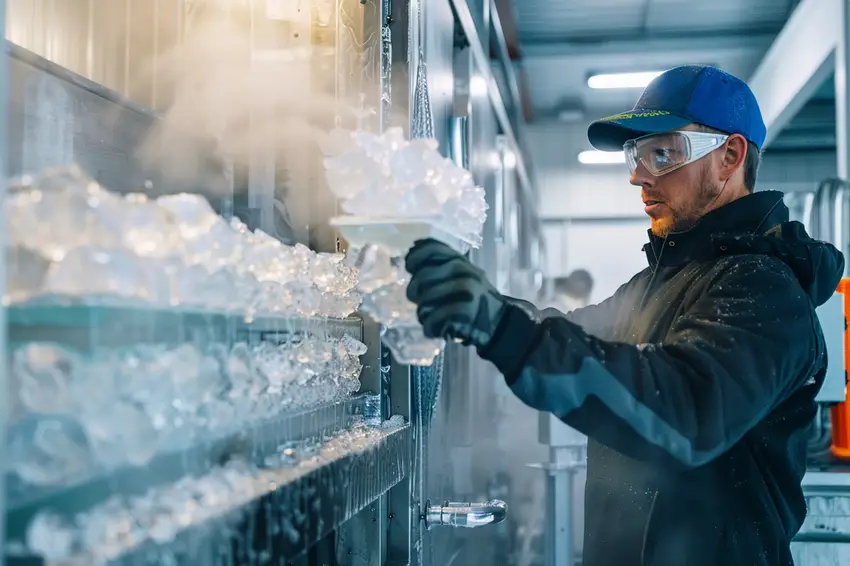
  • Scrape, dislodge, or break excess frost, ice, or frozen product from equipment to prevent accumulation, using hands and hand tools.
  • Activate mechanical rakes to regulate flow of ice from storage bins to vats.
  • Start machinery, such as pumps, feeders, or conveyors, and turn valves to heat, admit, or transfer products, refrigerants, or mixes.
  • Adjust machine or freezer speed and air intake to obtain desired consistency and amount of product.
  • Stir material with spoons or paddles to mix ingredients or allow even cooling and prevent coagulation.
  • Load and position wrapping paper, sticks, bags, or cartons into dispensing machines.
  • Place or position containers into equipment, and remove containers after completion of cooling or freezing processes.

Career Considerations

EPA Certification Requirements

Cooling technicians must obtain EPA Section 608 certification to legally handle refrigerants, which is mandatory for most HVAC and refrigeration work in the United States.

Seasonal Demand Fluctuations

Work demand typically peaks during summer months and decreases in winter, potentially affecting income stability and requiring financial planning for slower periods.

Physical Demands and Safety Risks

The job involves working in confined spaces, lifting heavy equipment, and exposure to electrical hazards, requiring strong physical fitness and adherence to safety protocols.

Want to dig deeper?

Talk to blinky to learn more.

Start chatting
BETA
New York

25 Kent Ave, Suite 401
Brooklyn, NY
11249


North Carolina

204 N Person
Street. Raleigh, NC
27601

Australia

Level 4/80
Wentworth Ave,
Surry Hills,
Sydney, 2010