Solar Photovoltaic Installers
Overview
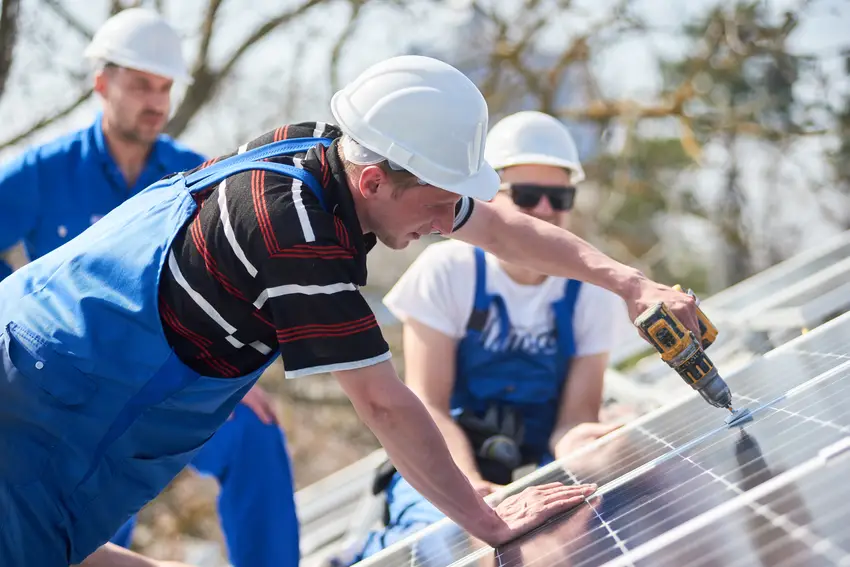
Solar Photovoltaic Installers work on rooftops and other locations to set up solar panel systems that turn sunlight into electricity. They plan system layouts, measure and cut materials, install solar panels and support structures, and connect everything to electrical systems using specialized tools and safety equipment. This hands-on career combines construction skills with green technology knowledge, and many installers learn through apprenticeships or technical programs. The work often involves teamwork, problem-solving, and contributing to clean energy solutions that help fight climate change.
Did you know?
Solar panel installers must be comfortable working at heights on rooftops and follow strict OSHA safety protocols to prevent falls and electrical hazards.
At a Glance
Median Wage
$54,677.41 Avg/yr
Growth
Fast Growing
Top Skill
Operations Monitoring
Key Responsibilities
- Test operating voltages to ensure operation within acceptable limits for power conditioning equipment, such as inverters and controllers.
- Assemble solar modules, panels, or support structures, as specified.
- Identify electrical, environmental, and safety hazards associated with photovoltaic (PV) installations.
- Install module array interconnect wiring, implementing measures to disable arrays during installation.
- Visually inspect and test photovoltaic (PV) modules or systems.
- Identify installation locations with proper orientation, area, solar access, or structural integrity for photovoltaic (PV) arrays.
- Diagram layouts and locations for photovoltaic (PV) arrays and equipment, including existing building or site features.
- Demonstrate system functionality and performance, including start-up, shut-down, normal operation, and emergency or bypass operations.
- Determine connection interfaces for additional subpanels or for connecting photovoltaic (PV) systems with utility services or other power generation sources.
- Install active solar systems, including solar collectors, concentrators, pumps, or fans.
- Check electrical installation for proper wiring, polarity, grounding, or integrity of terminations.
- Determine appropriate sizes, ratings, and locations for all system overcurrent devices, disconnect devices, grounding equipment, and surge suppression equipment.
- Activate photovoltaic (PV) systems to verify system functionality and conformity to performance expectations.
- Install required labels on solar system components and hardware.
- Apply weather sealing to array, building, or support mechanisms.
- Compile or maintain records of system operation, performance, and maintenance.
- Identify and resolve any deficiencies in photovoltaic (PV) system installation or materials.
- Select mechanical designs, installation equipment, or installation plans that conform to environmental, architectural, structural, site, and code requirements.
- Examine designs to determine current requirements for all parts of the photovoltaic (PV) system electrical circuit.
- Install photovoltaic (PV) systems in accordance with codes and standards, using drawings, schematics, and instructions.
- Determine materials, equipment, and installation sequences necessary to maximize installation efficiency.
- Determine photovoltaic (PV) system designs or configurations based on factors such as customer needs, expectations, and site conditions.
- Program, adjust, or configure inverters and controls for desired set points and operating modes.
- Identify methods for laying out, orienting, and mounting modules or arrays to ensure efficient installation, electrical configuration, or system maintenance.
- Perform routine photovoltaic (PV) system maintenance on modules, arrays, batteries, power conditioning equipment, safety systems, structural systems, weather sealing, or balance of systems equipment.
- Measure and analyze system performance and operating parameters to assess operating condition of systems or equipment.
Career Considerations
Physical Demands and Safety Requirements
Solar panel installers must be comfortable working at heights on rooftops and follow strict OSHA safety protocols to prevent falls and electrical hazards.
Certification and Training Needs
Most employers prefer candidates with NABCEP (North American Board of Certified Energy Practitioners) certification and completion of solar installation training programs.
Market Growth and Policy Dependence
The solar installation industry is experiencing rapid growth in the US, but job stability can be influenced by changes in federal tax credits and state renewable energy policies.